August 13, 2018

Plant of the Week: Lemony Lace® Sambucus


Hello and Happy Monday!

This week I'm in Chicago for the GWA Annual Conference and Expo and the IGC Show, so I'm re-running one of Shannon's posts from a few years ago about a plant that I just love to see in landscapes, Lemony Lace® Sambucus. It has the same gorgeous finely cut foliage that is reminiscent of Black Lace®  Sambucus Nigra, but in a more compact form and with spectacular chartreuse foliage.

A few weeks ago I wrote an article for GardenSmart about identifying the different types of Sambucus, especially for those who wish to harvest the fruit or flowers for consumption. Since then I've been fascinated by this garden giant and have planted two Laced Up® elderberry plants along the back fence of my backyard. They just stand there happily like two sturdy little soldiers in my well-drained sandy soil, enjoying the heat of the summer. They are so easy to maintain, perhaps there's a Lemony Lace® Sambucus in my future as well!


Bring on the Hullabaloo!

Lemony Lace® elderberry (Sambucus racemosa) has developed a reputation as a bit of an attention hog. It's been known to beckon garden writers to come closer and ask, "What is that? Tiger Eyes Sumac?" No, no, friends, it is something much better. Same color, but more compact, non-suckering, and with flowers.

Already an award winner, it boasts honors at the Farwest show in Portland, OR, and won The Garden Center Group Retailers Choice Award. Danny Summers, Managing Director for The Garden Center Group, remarked, “This distinctive golden, thread-like foliage looks wonderful in mixed borders or as a high-impact specimen plant."

Why the hullabaloo? Lemony Lace® elderberry's golden yellow, finely-cut foliage is highlighted by red new growth to create eye-catching texture in the landscape. Better color retention and sun tolerance make it an option for both full sun and part shade gardens. At 3-5’ tall and wide, it is more compact than ‘Sutherland Gold’ and also features more deeply cut foliage. White spring flowers produce red fruit in fall when pollinated*. This North American native is deer resistant and hardy to USDA Zone 3.

No wonder it's showboating across the country. Lemony Lace® elderberry possesses a versatile set of characteristics: multi-season interest, native, deer resistance, cold hardy, fruit for the birds, compact for small gardens... all deserving story topics.
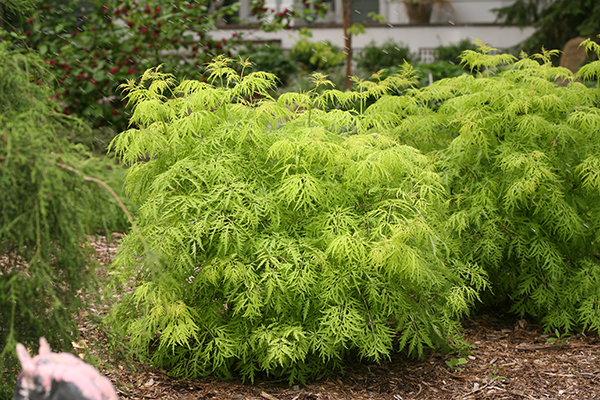
Lemony Lace elderberry in the landscape: add a pair of googly eyes, and you'd have the most adorable muppet.

The red new growth contrasts with the lemon-lime foliage.

*A note from Natalie: like Sambucus Nigra, this plants needs another variety of Sambucus Racemosa to produce fruit.

August 7, 2018

Plant of the Week: Incrediball® Hydrangea arborescens.

Jane's most current plant of the week is devoted to the concept of white space. And she has quite a lot to say about it! So this week I'm devoting the intro and the Plant of the Week to Jane's musings. Enjoy! - Natalie 


Graphic designers love their white space.

Incrediball®  hydrangea at BH&G Test Garden
If you've ever looked at a poster or flyer and liked it better than others without knowing why, white space could be the answer. Sometimes it's what isn't on the page that makes the whole thing better.

Gardens can be like that, too. Professional designers know what they're doing, but homeowners are often seduced by brilliant color and lots of it. They can forget that simple white flowers add elegance to spaces and can make an average yard into something special.

Some people go so far as to create a white garden, planting only varieties with white flowers or white variegation. That's fine, but even those who aren't ready for a monochromatic commitment can incorporate some white flowers into their landscape. In addition to being quite pretty in their own right, white flowers can be just what the eye needs to appreciate bright reds and hot pinks.

White flowers like this week's featured plant,  Incrediball® Hydrangea arborescens are perfect for inviting us to sit outside and enjoy a summer evening, something I think we all need more of.

People need their white space, too; an overly full schedule can lead to sleeplessness, caffeine-dependence, and general crankiness. Don't be that person. Plan (and plant) for some white space in your life.


Simply Beautiful.

Last week we looked at Hydrangea macrophylla. Pretty, but complicated.

How about something simple? That's Incrediball® Hydrangea arborescens. You plant it, and it produces white flowers. That's it. No fussing with the soil, no worries about flowers making it through the winter.

H. arborescens flowers on new wood, so cutting it back in late winter or early spring is good. By this time of the year, the new growth has produced plenty of flowers.

Incrediball® was selected for its large flowers and sturdy stems. The really super-sized blooms come from mature plants; regular watering will help them reach their maximum size.

This plant gets 4-5' tall and wide. Don't cramp its style by forcing it into a small space (check out a dwarf variety like Invincibelle® Wee White if you don't have room).


Full sun to part shade works, and the plant is hardy to USDA Zone 3. Finally, check out this garden tour from Garden Answer. At about the 23-minute mark she shows where she will plant her Incrediball® hydrangeas. I think she must have hedgerow envy of the scene above.

Plant of the Week is written by Jane Beggs-Joles. 

August 1, 2018

Plant of the Week: Let's Dance® Blue Jangles® Hydrangea macrophylla.


Hello garden lovers!

Yesterday we moved into our new offices at Spring Meadow Nursery. For those of you who don't know, the offices at Spring Meadow burned to the ground in January 2017. But I'm happy to say, that after working in very close quarters for about nine months (a year and a half for those who were here pre-fire), this has been a very exciting week! 
Marketing department - old office
Marketing department - new office
Here are some before and after photos of the marketing dept. just to give you an idea of what a big change we're experiencing.

We're still unpacking and there are finishing touches yet to be done, (like the glass toppers between the partitions) but I feel more productive already!

So, even though we are anything but blue this week, I have a blue post to pass on to you from Jane. 

When I was linking to this plant, I wondered "what's the difference between Let's Dance
® Rhythmic Blue and Let's Dance® Blue Jangles hydrangea? Ah-ha! This is where the Spring Meadow Nursery website plant comparison tool comes in handy!

At any rate, both of these blue hydrangeas are superstars. Enjoy the plant of the week and this beautiful week in general, and I'll do the same!
-Natalie

Meet Let's Dance® Blue Jangles® Hydrangea macrophylla. Like the other Let's Dance® hydrangeas, this is a reblooming variety that will flower on both old and new wood. Blue Jangles® is an exceptionally strong rebloomer and has brilliant, vibrant flower color.

Here's a video that shows it in both pink and blue...

This is a compact plant, kind of like the Cityline® varieties only it is a rebloomer. It will grow 1-2' tall and wide and is hardy to USDA Zone 5. Plant it in full sun or partial shade, but remember that H. macrophylla like moist soil. 

So many questions...Hydrangeas are a leading topic of questions on the Proven Winners feedback site.
The most common questions are:
1. Why they don't bloom, and 
2. How to get the desired color.

Our Hydrangeas Demystified flyer addresses these questions and guides people to the right hydrangea for their situation. If you haven't shared this piece with your readers, please do. It will make you a hero.

Another common question concerns wilting. Hydrangeas, especially H. macrophylla, do have a tendency to wilt. Unsurprisingly, most people don't like it when your response is, "Yep. They do that." They want to know why, and how to keep it from happening.

Even hydrangeas in moist soil can wilt if they are in full sun and it's hot. This is because the roots just can't take up enough moisture to compensate for what is being lost through the foliage. The fancy impress-the-rocket-scientist-next-door word for this is transpiration. 

The good news is that this sort of wilting won't hurt the plant as long as the roots are getting enough moisture to catch up when the temperature cools down at night. But if it's happening regularly it's a sign that the plant would be happier in more shade.

Plant of the Week is written by Jane Beggs-Joles.